The Many Lives I’ve Lived

Father. Photographer. Writer. Trader.

  • In an ideal world, the media’s role in race relations would be non-existent or one of breaking down race barriers instead of reinforcing them as the Kerner Commission report suggests they do. I tend to turn away from or try to ignore media where I can clearly see a bias. I prefer to focus solely on building personal relationships with people based off their character when it involves me directly. This is something I wish more people would do in their own lives.

    I was born in NY, specifically in the very segregated areas of Suffolk County Long Island. When I was 22yrs old I moved to Camden, NJ to volunteer At Urban Promise, working with youth in, what was at the time, America’s most dangerous and most impoverished city. When I returned from Camden, I moved to Jamaica Queens before settling in Bay Ridge, Brooklyn. I have visited 47 states in this country and have zig zagged across America almost a dozen times. I have traveled enough and lived in enough cities and suburbs to have seen just about every single stereotype perpetrated and defeated. Yet, we are constantly shown these stereotypes in media, and they’re repeated among our friends, family and coworkers. I believe much of this comes from two primary sources; media portrayals and hatred passed down through generations from our elders.

    I would love to see a world where stereotypes in media are never portrayed to begin with so that those who aren’t well traveled or well cultured don’t let media influence their relations with other races. Obviously, it’s impossible to stop stereotypes and bigotry from being taught in the home but it’s very difficult to fight against stereotypes and bigotry when young kids hear them at home and have them reinforced when media shows them views of the world outside their home. It misleads our children to believe that this is what it is like everywhere. These young kids start looking for those stereotypes in their own lives and will often ignore all the good traits and characteristics within people of other races because they don’t fit the narrative that they’ve been taught. The moment they see a stereotype play out in real life, it becomes a “see, I told you so” moment instead of recognizing that individual people make bad choices sometimes and that it’s not overly reflective of what an entire race is about.

    Some of the most racist people I know are folks from my childhood neighborhood who never moved out of their town yet have no real-world experience dealing with other races that would lead them to believe the stereotypes that they do. All of it comes from their parents or media. This is something I have seen play out in my hometown countless times. I stopped talking to most of the people I grew up with because of this. The friends I still have there are either all minorities or are among the lucky few who wanted better for their own future, and that of their kids, and chose to move away. I have zero room for bigotry in my life. Hearing things like “These mfs live off the system”, as if many of the minorities they speak of, have a choice. I don’t think half these people I know would make it out of the poverty that many minorities grow up in even if they lived through it as white men. It’s hard enough getting up out of poverty without having to deal with all the oppression, racism and stereotypes that come with being a member of the AHANA community. I know this through my own experience.

    When I moved to Jamaica, Queens I was flat broke. I had enough money for a deposit on a single room in a building that rented rooms for $150/wk. There were weeks where I hid from my landlord because I didn’t have the money for rent. Fortunately for me, my landlord, an Indian woman named Molly, was extremely patient and allowed me to stay. It took me almost 4 years before I made enough money to sustain myself. I couldn’t make it by finding a local job. I relied on contacts I had from my lily-white suburban hometown on Long Island to give me extra work as a photographer’s assistant covering weddings with them. I would not have been able to make it out of that neighborhood by working local jobs. People who grow up in the inner city typically don’t have the luxury I had. I was given that opportunity because of where I grew up. My parents did ok for themselves. We lived in a nice middle-class home in a very safe neighborhood. Growing up there afforded me the opportunity to make connections in business that would sustain me while I struggled to make ends meet. But how many inner-city youth have that luxury?

    I think the Horatio-Alger Myth which is pretty much identical to the American Dream narrative, stating that anyone from any background can make it with enough effort is one of the biggest lies being told. It is a hard thing to openly disagree with as doing so would be telling some people that they just flat out can’t make it because they are Black or Hispanic. I would never want to tell anyone they can’t do something but for many people, unfortunately, I believe it would be very difficult to nearly impossible to reach their dreams due to the overwhelming oppression that still exists. I think both the American Dream and the Horatio-Alger Myth are dangerous as they don’t really reflect the extra struggle that marginalized people feel when trying to make it. It’s the “well I did it, surely you can too or you’re just not determined enough” mentality, when the person having a hard time is probably working twice as hard as the person who already did it.

    To make it in this world, minorities must live and work with their character beyond reproach and that is a nearly impossible task for anyone to do. They must never be late, call out, have a bad day, or give their bosses any reason to believe they’re living up to the stereotypes peddled by media. We don’t have to look further than the Presidency of the United States to see this playing out in real time. The fact that President Obama’s most talked about scandal was him wearing a tan suit, while trump is a two time divorcee who cheated on his wives multiple times, paid off porn stars, was convicted of sexual assault that the judge categorized as rape, has been found liable for racial discrimination, tax discrepancies, trying to rig an election and then trying to overturn an election while half the country thinks he did nothing wrong and is the best President they’ve ever seen, shows you just how vastly different the expectations are of minorities.

    America is changing though. It’s change might not make it easier in the immediate future but long term, it’s the type of change this country needs. That change is being dubbed “the browning of America”. It is defined as the growing population of minority groups in relation to the majority white population currently seen as the dominant race. It is a real, measurable, change that is attributed to seven main factors. They are race mortality differences between whites and AHANA races, a higher AHANA birth rate than whites, rising immigration numbers, an increase in self-designation by AHANA peoples, an increase in multi-cultural designations on the US Census, a higher number of Interracial marriages and more accurate census racial categories. According to the Pew Research Center, within the next 20yrs, the United States will be comprised of a population where less than 50% of its citizens will be white. https://www.pewresearch.org/social-trends/2008/02/11/us-population-projections-2005-2050/. AHANA citizens already make up a majority of the populations of California, Texas, New Mexico, D.C. and Hawaii. The youth in America are already more than 50% AHANA and U.S. cities are roughly 50% AHANA majority as of today and that number is rapidly expanding.

    This change scares many white people. You can read about some of my personal experiences with white people who are “afraid” of America’s browning in my post titled “Farmingville”. Many white people are fighting back against this “browning.” Yes, the same white race who came here from somewhere else, took the land from the people who lived here, kidnapped and brought black slaves here from Africa and then used the Chinese to build its infrastructure is now afraid that everyone they brought will outnumber them. This country wouldn’t exist if it weren’t for minorities. There’s a reason America is the most powerful and most dominant nation in the world, and I believe it is primarily due to our diversity. We have people and ideas coming from a vast number of cultures and races. Whitewashing America is not the answer. America’s dominance in the global economy and as a military power grew at the same time people started emigrating to the US en masse. I think it’s only fitting that countries are catching up to us, now, economically while we are starting to really crack down on immigration and prevent the demographic effects of its expansion within our borders.

    The real question is, how do we get media to stop peddling stereotypes about minorities? Finding the answer to this question and implementing it is the best chance we have at slowing, minimizing or stopping racism and bigotry in America. The last place we will see change in the sharing and teaching of discrimination and stereotyping will be in the home. We have made great strides through affirmative action and other initiatives to prevent discrimination in the work place, schools and public facing institutions. But this is not enough. We need to start holding media accountable for the messages they share, the stories they frame and the ones they choose to ignore. We need to consume less biased media, start boycotting repeat offenders and start calling on our elected representatives to enact laws that create real, legal change. We need to put our words into action. We need to start calling out writers, editors and producers directly. We need to start calling and writing into newsrooms and copy desks pointing out flaws in their reporting. They are not going to change themselves. The damage they’re doing is catastrophic and might be the single greatest thing plaguing minorities in America.

    Stereotypes and racism aren’t just felt emotionally. They’re experienced physically as well. Critical Race Theory has shown us that we have a long way to go in the criminal court system as sentences are still shown to be harsher and laws more strictly applied to minorities than to the majority white race. (https://www.ussc.gov/research/research-reports/2023-demographic-differences-federal-sentencing)  Granted, things do seem better than they used to, they are still not fair. Police still overly target minorities in stops, abuse against Black and Hispanic citizens is higher than abuses against white citizens (https://pmc.ncbi.nlm.nih.gov/articles/PMC7331505/) and police stops lead to more frequent searches and tickets for Black citizens than it does for white citizens. (https://www.ppic.org/publication/racial-disparities-in-law-enforcement-stops/). According to these statistics by the National Library of Medicine, Black unarmed citizens are shot and killed by police at a rate almost 3x their demographic while unarmed White citizens are shot at a rate 33% LESS than their demographic.

    These numbers cause significant, lasting damage in their chances of getting ahead. The number of single parent households increases. The number of young boys growing up without fathers in their lives to coach them or guide them into becoming men increases. The number of young girls growing up without positive male role models who can show them through action, what a real man is and how he treats a lady increase. All of this causes young minority men and women to enter a world well behind the financial and social stability of their white counterparts. So, when they’re taking their shot at the “American Dream”, a lot of times their goal isn’t even extreme wealth or success, it’s simply to be treated as an equal. And how can that American Dream be realized when the entire media system that the White majority controls is set up to stereotype them and pushes people to discriminate against them to the point of failure?
  • I was two months into a relationship with an incredible woman. We both had a big weekend coming up. She worked for a nightclub in the Lower East Side of Manhattan while attending F.I.T. in Chelsea and was headed to the Sundance Film Festival where the club was throwing weekend afterparties for the movies being screened there. I was headed to Washington D.C. the next day, as a photographer contributing to Getty Images, who would be covering the events, galas and concerts surrounding the inauguration of our nation’s first black President, Barack Obama.

    We were in a taxi headed across 34th street in Manhattan towards her dorm on 31st street, between 9th and 10th avenues. As we approached the turn for 9th avenue which would take us south to her dorm, I received a phone call from a friend of mine who lived on 42nd street and 11th avenue. Her boyfriend and her were staring out the window when suddenly an airplane crashed into the river just one block away from her apartment. I’m not sure what made her think of me but I’m very thankful she did. I am also very thankful that I was always prepared to work. I was in my first month as a contributor with Getty, I had just signed my contract in December and whenever I came into the city from my Brooklyn apartment, I made sure my camera was with me just in case someone needed a photographer to cover an event. Event photography typically didn’t require us to carry a long lens but for some reason, that day, I had one on me.

    I turned to my girlfriend and said “I’m so sorry, but I have to go. I can’t take you to the airport. Just catch a cab.” I felt horrible. She was the sweetest person, and I was leaving her hanging just a couple of hours before her flight to one of the most important weekends of her life. I had the cab drop her off at her dorm and immediately take me to 34th street and the West Side Highway, which in that part of town is called 12th avenue.

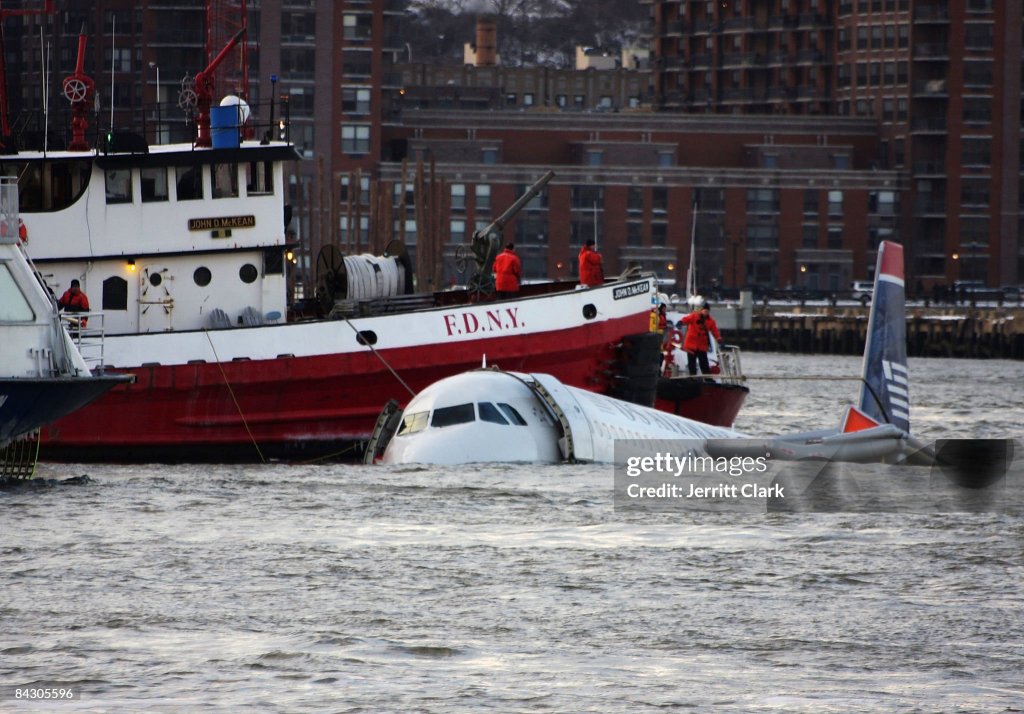
    When I got to the waterfront, I couldn’t believe my eyes. I was staring at US Airways Flight 1549 floating on the river. I was numb from both the shock of what I was looking at, the thought that there could be people on that plane drowning as we speak and the fact that it was 19 damn degrees outside. I put the long lens on my camera and started snapping pictures. The 75-300mm lens that I had allowed me to zoom in and clearly see rescuers escorting passengers away as well as fire, police, ferries and tugboats tying ropes around the plane to prevent it from sinking. Sinking meant two bad scenarios. Just beneath 34th street in the Hudson River is the Midtown Tunnel. A plane that large sinking to the bottom of the riverbed at a quick rate of speed could potentially put too much weight on the tunnel and risk collapsing on passenger cars traveling through it. The second scenario is once it sinks, the plane could break apart in the river and make recovery and removal efforts quite difficult.

    The Hudson River is a steady moving body of water which meant in one hour, the plane could be washed into NY Harbor and potentially affect boats and ferries moving throughout the area. This also meant that the plane I was trying to photograph was moving down river, away from me at a rate of 3mph, which is roughly a brisk walking pace. I began to run down the path along the river to get ahead of the plane so I could keep documenting the recovery and rescue efforts. Every so often I would come to a pier and would sprint to the end of the pier to be closer to the plane which allowed for the best shots I captured all day.

    When I came to Chelsea Pier, the FBI and NYPD were already there and were starting to block off the areas around the river. At this point no one knew if it was a terrorist attack or just a mechanical failure, so the scene was tense. As I tried running to the end of Chelsea Pier I was asked by an FBI Agent for my ID, I opened my wallet and right in the clear window of my wallet was a business card which was given to me by a DEA friend of mine. I went to go pull out my drivers license to show the agent, he saw the DEA card and said, “You’re good, go ahead”. I looked down and said “What?”. He ran to assist fellow agents, and I said to myself, “oh damn, he thought that card is mine.” I didn’t hesitate and used this opportunity to run to the end of the pier and snap a few more photos.

    At this point, my fingers were numb. I couldn’t move them and had to put them under my jacket to heat them up for a moment before continuing to take photos.

    I left Chelsea Pier and continued following the plane down towards Canal Street, roughly 40 blocks or two miles from where I started. I was frozen, I was exhausted, but I knew what I had was breaking news. I hadn’t seen another photographer in that entire stretch. Could I have an exclusive on my hands?

    I phoned my office and told them I got shots of the plane on the Hudson River. They said they’re all set and were sending someone down there right now. I replied “no, I HAVE the photos already. I’ve been photographing it for the last 30 minutes.” My assignment editor said, “OMG, where are you and how fast can you get here?”. I told him I was in the lobby on my way up as we spoke. Getty Images has an office on Canal and Varick Street just north of Tribeca which was four blocks from where I left the plane. I ran into the office and threw my memory cards on the desk and said here, take them, my hands are numb. Every editor in the building crowded around and reviewed the images. They picked the best 5 shots of the bunch, turned to me and made me an offer that I immediately accepted.

    It was the third thing I had shot for Getty, the first two, being events. I got some press coverage for the events I shot but the pick-up on these images would shock me more than the plane crash itself.

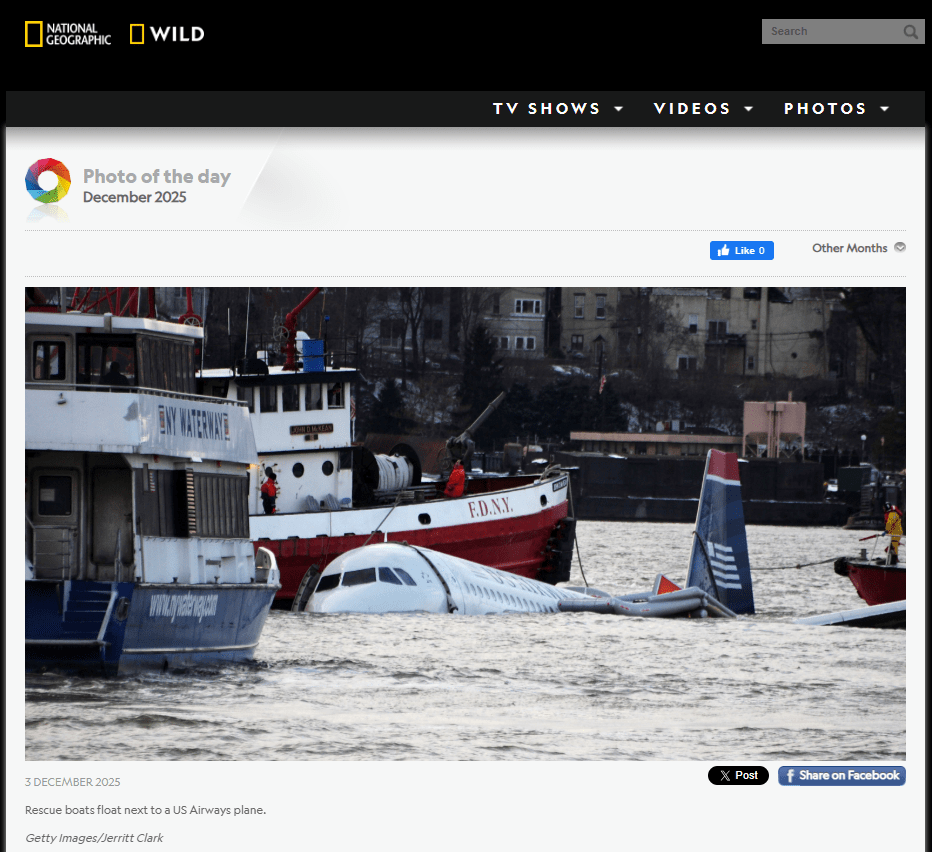
    I left for D.C. the next morning and walked into a 7-11 to get some snacks. I turned and looked at the newspapers beside me and all but one of the papers used my images, many of them on the cover. I started getting Google alerts on my phone that continue to this day, almost 17 years later. Just two days ago on December 3, 2025, NatGeo named my photo to their “Photo of the Day” list, highlighting groundbreaking photos and moments throughout history. Why did they pick this image on December 3rd? I’m not sure, but hey, I’m not complaining either. I’ve been contributing to Getty Images for 16yrs now and I don’t think I’ve had another photo do even half of what that image did as far as pickup.

    As for the girlfriend, she broke up with me while she was away. We are still friendly to this day and if you asked either of us if I should’ve left her stranded like that, I think we’d both agree that I made the right choice.

    NEW YORK – JANUARY 15: A New York City Fire Department boat floats next to a US Airways plane floating in the water after crashing into the Hudson River in the afternoon on January 15, 2009 in New York City. The Airbus 320 flight 1549 crashed shortly after take-off from LaGuardia Airport heading to Charlotte, North Carolina. (Photo by Jerritt Clark/Getty Images)
  • Racism… a quality of lesser men/ 
    hatreds veterans/
    I was under the impression when/
    My parents were kids this country had already got its civil rights lesson in/
    But, I guess I need to guess again/
    It seems the negative rhetoric the rights elected in, has effected men/
    White pride beats in the chest of men/
    Preparing for a fight near the home of Thomas Jefferson/
    dressed in bed sheets carrying tiki torches ready to let their weapons end…
    The lives of what they think is the lesser skin/
    Once the damage assessments in, notify the next of kin/
    Read about it from the press in print/
    But when the print impressions are in/
    The people are polarized, they dip a toe, but no ones getting in/
    Black square social posts aside/
    It’s no surprise to minority folks with older hides/
    They told you guys what they had to go through and you rolled your eyes/ 
    They marched with control and pride/
    And engrained their knowledge in our heads so we could hold them high/
    Believe me, the death toll will rise/
    If we don’t continue to fight for equal rights and hold our lines/
    Rights for which our soldiers died/
    For every black American, who faced a Klan that carried clubs, while they were simply holding signs/
    For every slave that was sold in lines/
    I will fight until the final time I close my eyes/
    For every man, woman and child who lives and breathes to also have a soul that thrives/

  • I have traveled to 47 states in America. I have taken dozens of road trips and zigzagged this country 10 times. I have stayed in big cities, small towns, rural communities and all along my travels, I have seen blatant, in your face, racism. I have seen segregation and oppression in middle America. I have seen loud, proud deep south racism and I have seen up close and personal bigotry and downright horrid things happen in my suburban hometown in the Northeast. It exists… everywhere. People often say news media is to blame for the division in America and that the people, when you meet them or get to know them are kind, loving and accepting. I vehemently disagree.

    If you are a minority who hasn’t experienced racism firsthand, congrats, but as a white man, I can tell you, it’s there. Growing up as a white man in Long Island, you are surrounded by people who say racist things about minorities to other white people but would never repeat these things in front of the minorities themselves. The judgement exists. The fair chance you might think you’re getting is not fair at all. I believe the majority of racism happens behind the scenes, but I have seen many instances where that racism has been bold enough to show up on people’s doorsteps. Below are a few examples I saw when I was between the ages of 14-18 years old.

    It was the Summer of 1996, July to be exact; I was 14 years old. My mom, siblings and I had just returned to our quiet suburban Long Island neighborhood from picking up two exchange students who were coming to live with us for 3 weeks. Tomas and Roman, both from France, were the same age as me and had come to America as part of a foreign exchange student program through my French class, except there was no exchange. My siblings and I didn’t go to France, our family just accepted French students who were to come to America and see our way of life, attend our schools or summer camps with us and tour New York City.

    Just as we showed them to their room in our 6-bedroom home in Farmingville, NY, a breaking news story flashed across the tv screen. TWA Flight 800 which was headed to Italy with a layover in Paris, France, had blown up over the Atlantic Ocean, 20 miles south of East Moriches. The exchange students had just arrived on a TWA flight from Paris and were shocked in horror. It was rare for a plane to blow up midair and immediately everyone suspected foul play. I suspected foul play because my dad ran a construction company out of West Hampton Beach, 7 miles from where this happened, and used to tell us stories of military aircraft shooting things out of the sky for practice. All of the initial reports from eyewitnesses say they saw a streak come up from the ocean and explode upon impacting the plane and then a second explosion when the gas from the plane itself blew up. But, that’s a story for another day…

    Before we had a chance to grasp the number of lives lost and just how close it was to where we lived, a loud explosion happened that shook the windows of my home. Everyone ducked in fear. We heard metal crashing onto the roof of our home and various pieces of metal and wood falling to the street out front. Was it another plane?  

    When we looked out the window, we saw smoke coming from the area where my neighbor’s mailbox used to be and saw a younger, hooded figure running up the street away from the blast. It turns out that someone had stuck a half a stick of dynamite in my neighbor Ryan’s mailbox and sent pieces of it flying 120ft away onto our two-story home. The French kids were both terrified. Their first five hours in NY and already they’ve heard the news of a plane crash and now a small bombing outside our front door. No one knew what to think.

    Just as we were about to walk outside, my neighbor Ryan, whose family lived diagonally across the street from us to the left, came out to his driveway with a mag-lite flashlight to inspect the damage and figure out what happened. Ryan was a man of Jewish faith who lived at home with his wife and two daughters, the oldest of which, Ariel, was my age and was a close friend. 

    In the next few moments, almost every neighbor on our block either came outside or was glued to their windows. One of those neighbors, Lester, lived to the left of us directly across the street from Ryan, with his wife and 3 boys. Lester was a postal worker and was known to be a bit of a nut job. He was of German descent and was known to be a bit of a racist. He was also known to be a gun fanatic and had taught all 3 of his boys how to fight. Lester was a bit of a fighter himself and would often whoop his kids and even his wife on occasion. He came out to see what the commotion was about and went up to Ryan who was irate at this point and started blaming Lester’s kids for the damage. Quite frankly, we all did. No one else in that neighborhood would even know where to get a half a stick of dynamite, let alone have the gall to set it off in someone else’s mailbox.

    Lester didn’t take kindly to that accusation. He proceeded to walk right up to Ryan and get in his face as they began bumping chests in anger hoping the other one would swing first. Before you knew it, they were rolling around on the ground throwing fists and trying to pummel each other. Right in the middle of the fight, Lester yelled to his wife “Maggie, get my gun! I’m going to shoot this mother fucker!”. Fortunately, for Ryan, Maggie did not go retrieve Lester’s gun for him.

    We all knew then, in our hearts, that Alex, the middle boy in the family who was the same age as Ariel and me, was the one who did it. He was the only one who fit the build of the runner we saw and years later he would later confirm it was him.

    It was obvious to us then, that this happened because Ryan’s family was Jewish and Lester taught his boys to hate anyone who wasn’t white and Christian. Seeing a menorah every holiday season when he walked out his front door must have driven him nuts. Every other family in the neighborhood got along well with Ryan and his kids. My sister Meg was best friends with Ariel’s little sister. Lester’s family were the odd sheep on the block. They put up a wall of hedges 8ft tall around their property and kept secluded, like they lived in some sort of compound. Things in my neighborhood were never the same after that. It seemed like the perfect picturesque American neighborhood had a dark side that we were all just beginning to learn about.

    Alex was a good friend of mine and would grow up to be a stand-up guy from what I can tell. I hope he left that hatred that his father taught him behind and doesn’t pass it on to his kids. Kids are so impressionable and a 14yr old boy looks to his dad as his hero. Alex was no exception. Lester could have taught him great things, could have prepared him for a life of inclusion and love, but chose instead to fill his young boys with hatred. Fortunately for Alex, no one was injured, at least not physically.

    The 1990’s in Long Island were a major turning point in race relations and demographics. A 2002 story by the New York Times would later rate Long Island as the most segregated suburban community in America, https://www.nytimes.com/2002/06/05/nyregion/study-calls-li-most-segregated-suburb.html but that was beginning to change.

    An influx of undocumented immigrants to the small town of roughly 10,000 mostly white residents was not well received. About 10 houses away from me, a group of day laborers rented a two-story house and shared the costs of living and maintaining the house, while going down to Home Depot or 7-11 every morning to look for work. These were hard working men. They took any job that someone offered them if it meant they could end the day with more money in their pockets than they started with. Nothing was beneath them, which meant a lot to local contractors who needed labor to complete difficult tasks on job sites that required a lot of physicality. My father was one of those contractors. He would continuously hire day laborers to work jobs, that quite frankly, American workers were too lazy and unmotivated to do. I know this because when I turned 18, I went to work for my dad and watched the migrant workers skate circles around us while getting paid less than us and never complaining.

    These guys never bothered anyone. They worked long hours and would come home and remain in their houses until work the next day. This house had about 11 migrants crammed into a four-bedroom home at 1345 Waverly Avenue. That is, until the night someone lit the end of a gasoline-soaked rag that was sticking out of the end of a gasoline filled bottle and tossed it into one of the windows. Who the hell still makes Molotov cocktails?? Apparently, racist white people do. The men scattered out of various windows and ran away in horror as they watched everything they owned burn to the ground. These men didn’t have bank accounts. They didn’t have savings. They lived a cash life which meant everything, including their money was gone. Farmingville, NY has a volunteer fire department which means that firefighters must respond to sirens blasted throughout the town and rush to the fire house before hopping in trucks to go battle blazes. Unfortunately, most homes don’t make it as response times are often slow.

    This was a hate crime. Residents from the area were incensed that day laborers were moving into homes previously occupied by white families and someone decided to take it upon themselves to remove them. I remember hearing students on my school bus yelling racial epithets at them as we drove by. Some threw drinks and food at them. It was disgusting. This was not uncommon for Suffolk County. Residents looked at the migrant workers as roaches who were infesting their lily white towns.

    Race relations would only go downhill from here. On Sept. 17, 2000, Mexican day laborers Israel Perez and Magdaleno Estrada Escamilla showed up to 7-11 like they did every morning looking for work. When two men pulled up and offered them a job, the two laborers jumped at the opportunity and hopped in the car with Christopher Slavin and Ryan Wagner. What they didn’t realize was that Chris and Ryan didn’t have work for them.

    Slavin and Wagner drove the two workers to an abandoned factory in Shirley, NY about 20mins away from where they were picked up. They were told the job required them to help clear out the debris from the factory and they proceeded to take the two men to the basement of the factory where court documents explain the details of what happened next:

     “When they arrived, Petitioner [Slavin] and Wagner directed Pérez and Estrada to clean the basement of an abandoned building.  A few moments later, [Slavin] and his accomplice brutally attacked the two migrant workers; [Slavin] hit Estrada in the back of his head with a metal post-hole digger and Wagner stabbed Pérez with a folding knife. As [Slavin] continued to beat Estrada, Pérez attempted to escape but slipped while running.  While Pérez was on the ground, [Slavin] attempted to hit him with a post-hole digger; however, [Slavin] was not successful, and the digger only scraped Pérez’s head.  Eventually, the two victims managed to escape onto the Long Island Expressway.  A passing motorist called 911 after noticing the two victims covered in blood and standing in the way of traffic.”

    Fortunately, Perez and Estrada survived the attack, though, had it not been for fast thinking motorists and a quick response time from EMT’s, it is doubtful Perez would have made it due to the loss of blood from his seven stab wounds and a sliced wrist. Slavin and Wagner would eventually be convicted and receive 25yrs in prison for the attacks. Over the 12 months surrounding these attacks there were 5 dozen other such abductions and beatings of day laborers.

    These abuses led to protests and picketing at 7-11 and Home Depot on Horseblock Road in Farmingville for months, much of which can be seen in Farmingville, a 2004 documentary film that won the Special Jury Prize at the Sundance Film Festival. These events split the town into two. You either supported the laborers as human beings who just wanted to support their families, or you joined one of several hate groups that popped up in the area to sway legislation to have them permanently removed. Farmingville is only one such location where things like this happened in America. It happens to be the town I grew up in.

    If you visit Farmingville today, these same divides still exist. When I went back in 2019, I visited a restaurant, FaxChix, located directly across the street from the 7-11 where these events started. When I walked in, I was the only white person in the entire restaurant of about 50 people. Everyone stopped and looked at me. White people didn’t frequent the Mexican spots in Farmingville and Mexicans didn’t frequent the white owned restaurants. It’s the way it always has been, and I don’t see it changing anytime soon. I like Mexican food, and I love Mexican culture. My girlfriend is 100% Mexican, born in Mexicali. So, for me, I eat where I want to eat and socialize with everyone. Fortunately, I grew up more open minded than most of the people in my town. I have learned, in life, that experiencing various cultures and loving everyone as equals is the only way to live a completely full life. I really wish people would put hatred and prejudice behind them and take advantage of all the amazing things we have to offer each other while we are here together.

  • Emotions flow like ocean waters
    calmness comes before the storm is brought up
    smooth sailing turns
    and my eagerness to stay afloat earns me a day of hope
    as the waves sway my boat
    the skies gray from the clouded way i spoke
    trying to keep my bad thoughts at bay
    because the day i open my throat when the rain pours
    is the day i choke
    I’m not ready to drown
    I’m headed to steadier ground
    times are rough, but I’m looking up
    because I’ve already been down
    i cant tell if my cheeks are soaked in tears or in rain
    either way i know I’m in pain
    but i see brighter days pushing the stormy nights out
    sailing to the promised land with god as my lighthouse
    so i catch my bearing and get my sights set
    look passed the night
    and try to pay back what i owe for taking the last breath of Christ

  • I live in an era of heightened security
    where people still have to fight for human rights fervently
    for anyone to have heard them speak.
    There’s a disease within the government, their hearing is lessened,
    an ear infection steering them clear from the people they’re not hearing, stressing.
    We live in terms of tears yet we cheer elections.
    We hope for change yet after the campaign year has left us
    we’ve gained nothing but fear and lessons
    we don’t put to use because we fear we’re threatened.
    They use terrorism to keep their errors hidden
    and we’re die hard Americans, our pride is forever with them.
    I’m tired of being part of an alien nation,
    finding the land with the resources to stage an invasion,
    finding new ways to persuade them.
    Tell them under their government ways their rights have been taken.
    Act like we’re shedding their chains, when
    all we’re doing is taking their pictures to frame them,
    to show the world lies as to why we came and
    labeled them as terrorists so we don’t have to try them the same.
    Men crying in pain
    from interrogations with agents prying their brain.
    I’m trying to gain some knowledge to our lies that remain,
    but our truth is, it’s those lies that sustain this country’s pride and its name.
    I live in America where our government is the world’s most powerful weapon of mass destruction.
    We see families losing children and loved ones,
    all for oil and gas combustion..
    while we’re complaining our children are dying in a country we raided,
    where the death tolls were extremely understated.
    Sending our troops across burnt bridges so there’s no turning back for the ones that made it.
    A soldier is ill fated.
    Whether he’s there to kill or be killed, face it,
    the government’s got over a million replacements.
    They’re not trying for peace with anyone by putting a gun in their faces.
    If peace is what they wanted, they’d have spent less money on bombs and
    more on trying to restore honor.
    Those who don’t live under God, face karma,
    and a country who sins today.. tomorrow is a goner.